
Most of our clients arrive in the same posture: they have a real decision to make — a buy vs build decision, a tech & team to evaluate, a transaction to close, an MVP to harden — and they need senior technical judgment they can trust. They are not shopping for a staffing agency, and they are not looking for generic MBA advice. They want a clear answer and a credible path forward from experienced operators.
Three Ways We Engage
Develomentor engagements typically fall into three models. Most clients begin with the first and continue with the second or third when the situation warrants it.
1. Fixed-scope assessments. A defined piece of work with a clear deliverable, a fixed price, and a published timeline. Code reviews, architecture assessments, technical due diligence, and team evaluations all fit this model. You know what you are buying before you sign. Two productized starting points are listed on Founders & Small Teams: a Vibe to Production assessment at $7,200 for founders moving an AI-built MVP toward something production-grade, and a Small Business Health Check at $11,200–$18,600 for teams that need an outside read on the code, the architecture, and the people. Engagements spanning multiple codebases, repositories, or teams are custom-quoted to reflect the actual scope. Every fixed-scope assessment includes a one-year Aikido security subscription — so production exposure is visible from the first week, not discovered the hard way later.
2. Ongoing fractional leadership. A monthly engagement in which Grant and the Develomentor team are embedded as your fractional CTO, CPO, or technical leadership. We learn your business, attend the meetings that matter, write the strategy your board needs to see, lead the team, review the code, recommend architecture, improve engineering process, and run the hiring loops. Minimum commitment is three months — long enough to actually move the needle, short enough to remain genuinely fractional. You get senior judgment on a schedule your budget can sustain, without carrying a full executive salary and equity grant.
3. Project-based delivery. Larger builds and transformations: an AI/ML pipeline, a search replatform, a multi-team org assessment, an architecture review, App Dev, an M&A diligence sprint. These are scoped by phase — discovery, recommendation, build, handoff — with deliverables and decision points at each gate. Recent project-based engagements include a national education retailer (search and RFP architecture), a national media organization (full engineering org assessment), and several PE-backed diligence engagements. Each is shaped to the situation, but the cadence is the same: structured, written, and built to be auditable by your board or investment committee.
What the Process Actually Looks Like
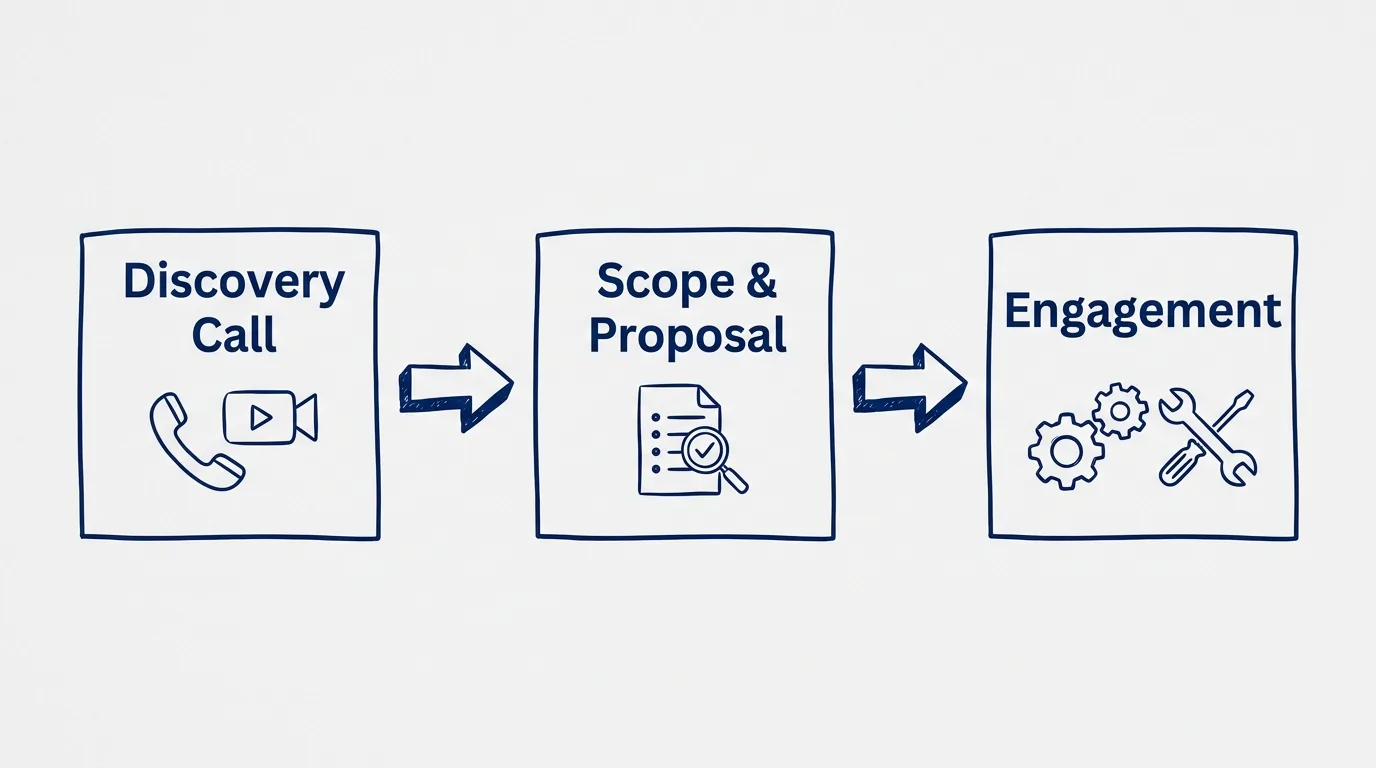
Step one: the discovery call. Thirty minutes with Grant. You describe the company, the problem, and what triggered the search for outside help. We ask about your team, your stack, your timeline, and the decision the engagement needs to support — board meeting, fundraise, acquisition, hiring plan, launch. By the end of the call, you will have a clear sense of whether this is the right fit, which of the three engagement models applies, and roughly what scope and budget to plan for. If we are not the right partner, we say so on the call and point you in a better direction.
Step two: scope and proposal. Within a few business days you receive a written proposal: the specific questions the engagement will answer, the deliverables you will receive, the timeline, the price, and who from the Develomentor team will be involved. For fixed-scope work the price is fixed. For fractional and project-based work the proposal lays out the cadence, the scope per phase, and the conditions under which scope would change.
Step three: the engagement itself. Work begins on a defined start date with a kickoff that aligns your stakeholders and ours. Inside the engagement you have a single point of contact — usually Grant — and a working cadence appropriate to the scope: weekly written updates for fractional and project work, milestone-driven check-ins for assessments. We meet you where you already operate (Slack, Linear, GitHub, your existing rituals) rather than asking you to adopt our tooling. Every engagement closes with a written deliverable and a readout session, so the value does not walk out the door with us.
What You Actually Receive
Every engagement closes with a deliverable and a readout session — the format depends on what your stakeholders will actually use.
Most clients choose one of two formats:
Written assessment. A structured document with prioritized findings, an action plan, and the rationale behind each recommendation — built to be forwarded to a board, an IC, an acquirer, or an engineering team without further translation. Written assessments take more time to produce and are priced accordingly, but they create a durable record your organization can act on long after the engagement ends.
Executive presentation. A tight slide deck — the findings, the risks, the recommendations, and the priorities — built for a live readout and designed to drive a decision in the room. Faster to produce, easier to present, and the right format for many boards and investment committees that want to move quickly.
Both formats include a 90-minute readout session with the engagement lead and your key stakeholders. Both can incorporate architecture diagrams, code-review summaries, security posture findings, or technical memos as the work requires. We scope the format during the proposal conversation — if you have a preference or a specific audience in mind, say so and we will build for it.
A Word on Pricing
The two productized assessments are listed at fixed prices: $7,200 and $11,200–$18,600. Beyond that, engagements are scoped and priced based on duration, scope, and the size of the team involved — including hourly engagements for advisory work and time-and-materials projects. Most fractional and project-based work is scoped during the discovery call and the written proposal that follows, so the price reflects the actual work. Hourly rates are available on request. For a fuller breakdown of pricing models and what drives them, see how much a fractional CTO costs.
Why Develomentor
Develomentor is led by Grant Ingersoll — former CTO of the Wikimedia Foundation (18 teams, 150+ engineers, 1.7B monthly pageviews), co-founder and CTO of Lucidworks, Apache Lucene/Solr committer, and author of Taming Text. Delivery is team-based: each engagement has a dedicated lead and draws on specialized Develomentor practitioners — search, ML, security, product, infrastructure — as the scope requires. Security work runs on Aikido, our continuous-monitoring partner, so production exposure is visible from the first week rather than discovered the hard way later.
Two Ways Forward
If you want to see the kind of work this produces, read a few case studies. The case studies describe the situation we walked into, the questions we were asked to answer, and what changed. They are the best way to understand the standard before you commit to a call.
If you already know enough and want to talk, book a discovery call below. Thirty minutes and a clear answer about whether and how we can help.