
The situation
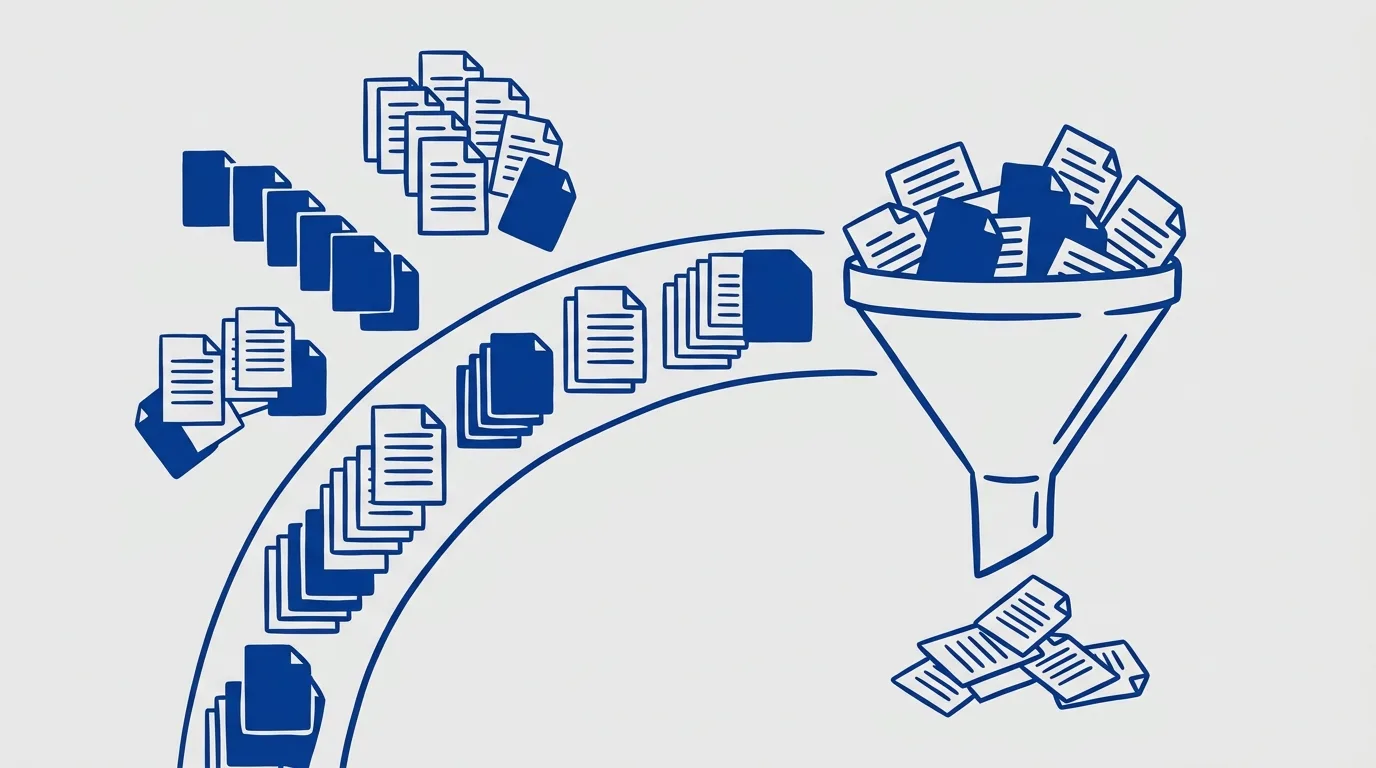
A national retailer of educational and classroom products sells through multiple direct channels — and a meaningful share of the business comes from RFPs issued by schools, school districts, and government agencies. The RFP analysis team ran the entire intake by hand. Every day, analysts checked a variety of RFP sources separately, one at a time, and triaged a stream of RFPs delivered directly to shared inboxes.
There was no fast way to tell whether an RFP was worth pursuing. Someone had to read each document end-to-end. Each RFP analyst kept a personal spreadsheet, so nothing was queryable across the team. Product R&D for gap analysis was one person reading twelve to eighteen months of prior RFPs and writing notes. There was no KPI visibility across the funnel — no way to see acquisition, response, or win-rate trends, and no baseline to catch a decline.
Two structural problems sat underneath the operational pain. RFPs outside those sources were invisible, which capped revenue. And volume was growing — adding more RFPs to a manual queue with no prioritization would reduce throughput, not increase it.
Why they called us
A referral brought them to Develomentor. The deciding factor was the shape of the team. The work needed practitioner depth in search, document processing, and applied ML — and Develomentor is led by Grant Ingersoll, co-founder of Apache Mahout, a core Lucene and Solr committer, OpenSearch contributor, and author of Taming Text. Build the same team inside the company and they were looking at a multi-million-dollar hiring effort. Hire a traditional consultancy and they were paying for layered overhead instead of senior practitioners on the keyboard. The fractional model gave them CTO-level technical strategy and a complete delivery team scaled to the engagement.
What we did
Led by Grant Ingersoll, the Develomentor team ran the engagement across three coordinated workstreams, with a Product Manager, a fractional CTO, a Tech Lead, a Designer, two full-stack developers, and an ML engineer.
Product
Our PM led discovery, interviewed RFP analysts and leadership, mapped the existing email-and-spreadsheet workflow in detail, and translated it into a phased build plan. Stakeholders saw working software early and often, and feedback from real RFP analysts shaped each phase before the next one started.
Engineering
The Tech Lead, full-stack developer, and UI engineer built the platform end-to-end:
- Crawlers that ingest RFPs from a variety of sources plus the team’s email channels, on a schedule, into a single pipeline.
- A document processing pipeline that handles the dense legalese, line-item purchasing data, and inconsistent formatting that comes with public-sector RFPs.
- OpenSearch as the backend for indexing, search, and retrieval across the full corpus.
- A workflow UI that captures the actual steps an RFP analyst takes — claim, review, qualify, respond, track — replacing the email-and-spreadsheet workflow with one shared system.
- Faceting and filtering on extracted fields: key dates, product categories, line-item products, customer information, and the RFP’s qualification score.
Data science
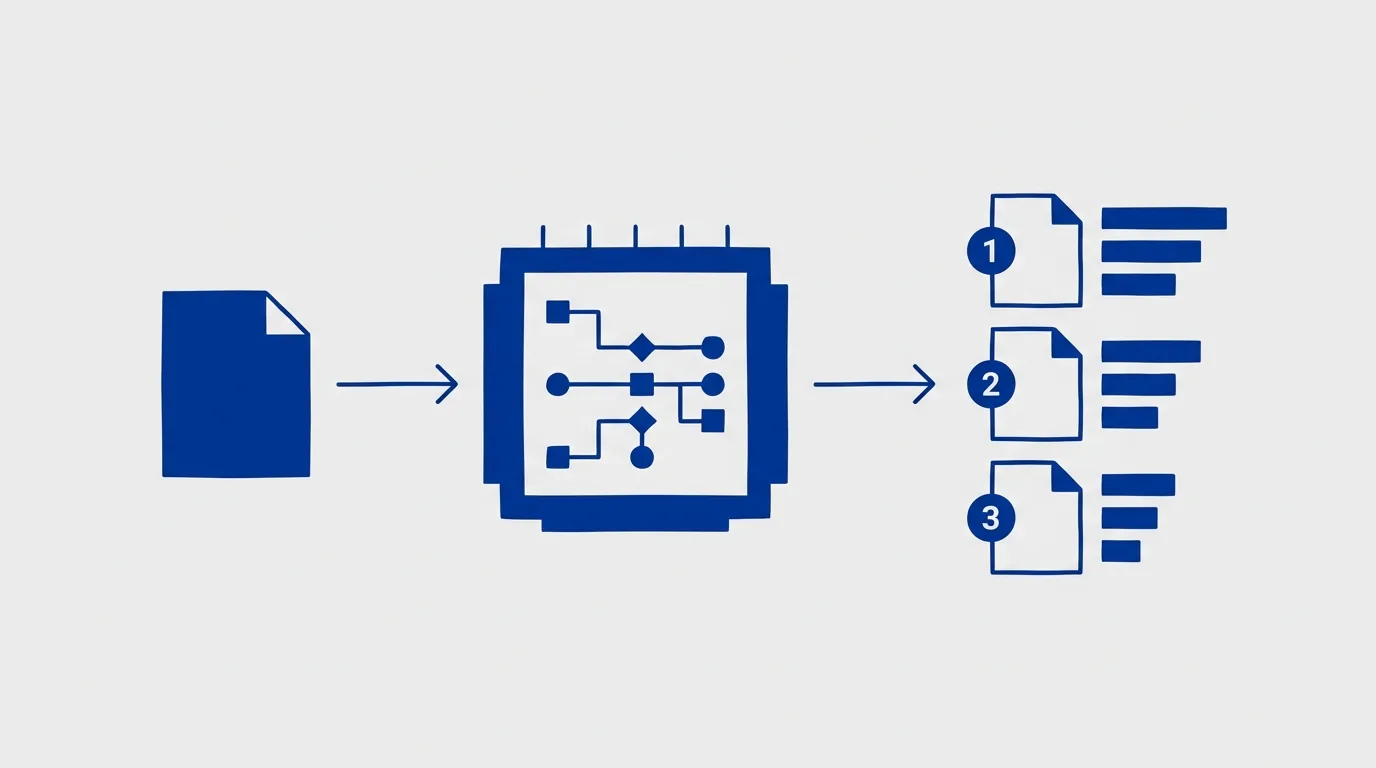
The Tech Lead and fractional CTO iterated on the intelligence layer. A combination of LLMs and classical AI techniques categorizes incoming RFPs and pulls out the purchasing signals that matter — products mentioned, quantities, deadlines, contract structure. A scoring model ranks each RFP by how qualified the company is to win it, so analysts work the highest-value RFPs first. Relevance was tuned through internal testing, focus groups with the RFP team, and a gold-standard set graded by domain experts — not by intuition.
The market research extension
Once the core RFP platform was in production, the same pipeline was extended to a second application. Instead of looking at RFPs to find ones the company should pursue, we analyzed them to surface the products the company did not yet manufacture — what schools and districts were buying that the company could not sell them. That gap data was aggregated into a market research tool the product R&D team now uses to inform new-product decisions, replacing one person’s manual review of a year and a half of RFPs with a systematic, queryable view of the market.
The result
The RFP team migrated entirely off Microsoft Outlook and personal spreadsheets onto the new platform. That, on its own, was the headline outcome — the operational pattern that had capped the team’s capacity is gone.
From that base, the company can now process and monitor a larger volume of incoming RFPs, with less time spent reading RFPs the company is unlikely to win. Product R&D gained a systematic, data-driven market research tool in place of a single person’s manual review. KPI visibility across acquisition, response, and outcome became possible for the first time.
Two facts speak for themselves. The RFP team works exclusively on the new platform — no one has gone back to the spreadsheet. And the engagement has run multiple years across multiple renewal cycles, expanding from one production application into a second strategic one on the same pipeline. Buyers do not renew this kind of work, repeatedly, against a platform their team is not actually using.
Structurally, the company can now react to RFPs at higher volume and higher quality, and it can see the product market in a way it could not see before.
What this means for you
If your team is moving high volumes of text-heavy documents through email, spreadsheets, or shared folders — RFPs, contracts, research filings, regulatory notices, legal documents — this pattern is yours. The specifics of the documents change. The shape of the problem does not: ingest, classify, rank, route, and learn from what you have.
You do not need to staff a search-and-ML team to do this. You need a fractional CTO and a senior delivery team who have built this kind of pipeline before — discovery in weeks, working software in the first phase, a team scaled to the engagement.
Most work like this starts with a focused discovery to map the current workflow and where automation has the highest leverage, then moves into a phased build. See how we structure engagements for what that looks like in practice — and if search quality is part of your problem, a Search Health Check is the fastest way to get an expert read.
Tell us what you are moving by hand. Book a Discovery Call.